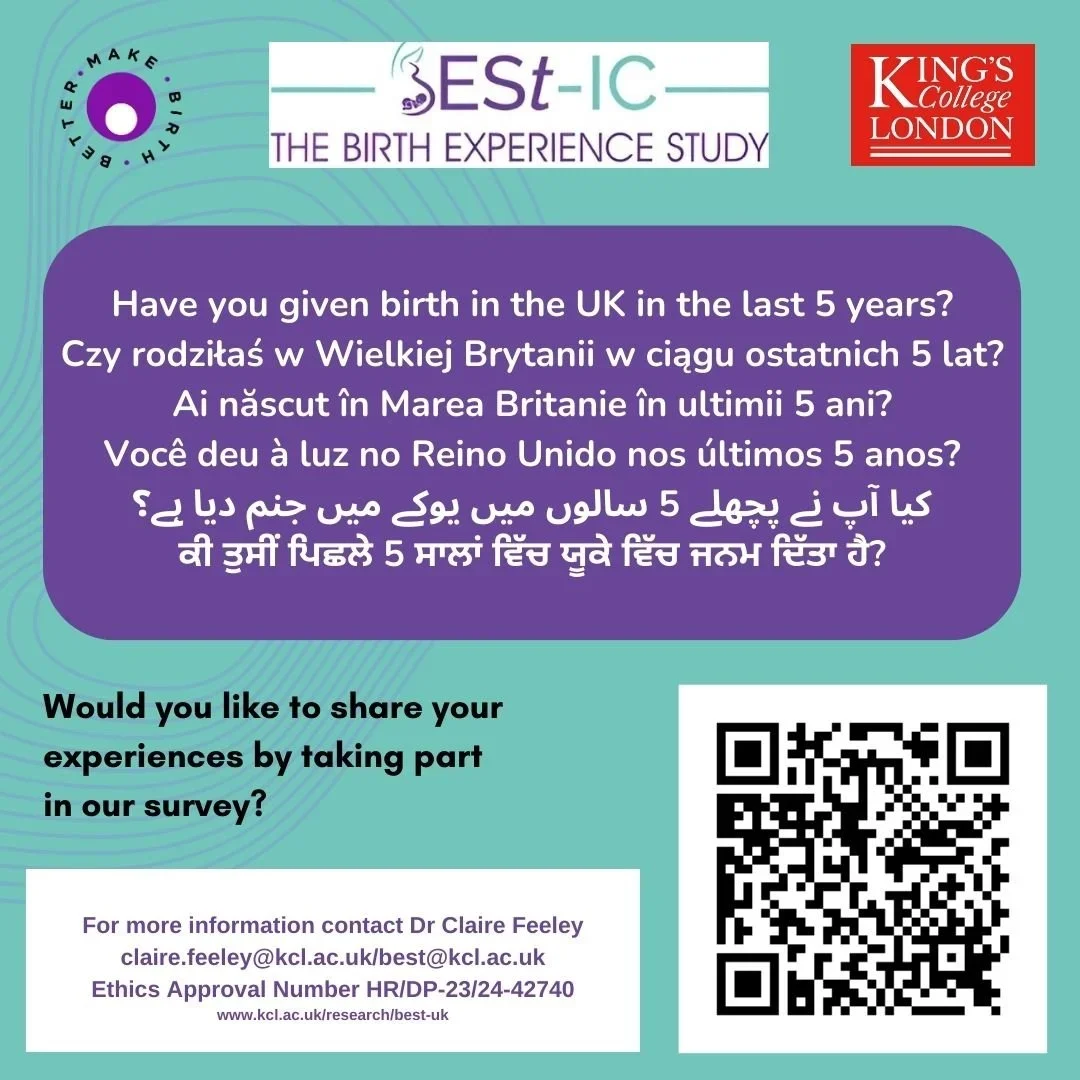
The BESt-UK Survey: we need your help
We are regularly asked for the source behind the statistic “1 in 3 women and birthing people find their birth as in some way traumatic” and we cite this great study from 2004 by Susan Ayres and her team of collaborators. However the date stamp on this study is now 20 years old and we desperately need contemporary data which reflects the post-Covid era. We also need more intelligent data. For example, right now we cannot tell you with any accuracy how much more likely you are to suffer from birth trauma if you’re from a marginalised group.
Truth Bomb
The study we cite which says that 1 in 3 women and birthing people experience their birth as traumatic, is 20 years old*. We desperately need an accurate post-Covid picture.
*Ayers, S. (2004). Delivery as a traumatic event: prevalence, risk factors, and treatment for postnatal posttraumatic stress disorder. Clinical Obstetrics and Gynecology, 47 (3), 552-567.
We urgently need new data
You may not know that the recent UK Public Inquiry (read more from Make Birth Better here and AIMS here) was inspired by a Public Inquiry which took place in New South Wales, Australia and also recently shared its report and recommendations (read more here). What’s more, the catalyst for the inquiry in Australia was a growing awareness of birth trauma which was in major part driven by the Australian Birth Experience Study (BESt (see here).
This study revealed that in Australia 28% of women and birthing people experienced birth trauma and more than 1 in 10 experienced some form of obstetric violence which left them feeling 'dehumanised, powerless and violated'. Crucially, it was also able to reveal how these rates change across vulnerable groups, for example:
Women and birthing people who felt disrespected due to having a higher BMI: 45% reported birth trauma and 1 in 4 reported some form of obstetric violence.
Young women and birthing people under 25: 41% reported birth trauma and 1 in 6 reported some form of obstetric violence.
Aboriginal and Torres Strait Islander (First Nations) women and birthing people: 37% reported birth trauma and 1 in 6 reported some form of obstetric violence.
Put simply, we need this kind of data for the UK. It will provide crucial context for our training, strengthen the arguments behind our campaigns and inform the NHS and our Government on birth trauma strategy.
BESt comes to the UK
The Birth Experiences Study (BESt) has now expanded into an international collaboration and is being launched across 13 countries around the globe. We are thrilled that Dr Claire Feeley and her team at Kings College London are leading this work for the UK (visit their website here). The BESt-UK study started setting up their work in October 2023 and have spent until now rigorously reproducing the study in coproduction so it is fit for the UK context and can capture all birth experiences.
How does this work link to the UK Public Inquiry into Birth Trauma?
This work is separate to the UK Public Inquiry into Birth Trauma. However we believe this study complements the work already completed and will offer crucial additional insights and perspectives. It’s also about ALL birth experiences - positive, negative or neutral.
The UK public inquiry was led by MP’s in the All Party Parliamentary Group for Birth Trauma. It’s vital that we have this academically grounded research as well as Members of Parliament calling for change.
If you shared your experience with the Public Inquiry into Birth Trauma, you don’t have to rush to share your story again. This survey is open until September so you have plenty of time. You may also feel that once is enough and that’s totally understandable.
If your reservations about sharing your experience in the BESt-UK survey come from a place of not feeling listened to by the inquiry, then please take a look at our seperate blog here which addresses some concerns you might have. Please contact us with any other questions or concerns. We’re listening, we promise.