
Our #thinktraumanow campaign
2020: campaign launch
Trauma prevention and treatment in light of Covid-19
Before the pandemic hit, birth trauma statistics already had a sobering status quo.
Add Covid-19 restrictions to the mix and you see trauma statistics skyrocket. This is why we launched #ThinkTraumaNow. Read about the campaign launch in 2020 here.
2023: next phase
We want everyone to know about birth trauma and how to find support
In 2023 we launched a new three year strategy for the next phase of Think Trauma Now which we co-produced with our champions. Our three year plan builds on our campaign learnings since its launch at the start of the pandemic. Our mission focus: we want everyone to know about birth trauma and how to find support.
In 2024 we were proud to welcome The National Lottery Community Fund as the primary funder of this campaign. In addition, we were pleased to receive funding from the Rosa Foundation and their Voices from The Frontline Fund in March 2025. We thank them enormously for their support.


“We need birth trauma to be as well-known as PND and the menopause”

We want everyone to know about birth trauma
Public awareness is critical to driving lasting change. Many parents are unaware that they are suffering from trauma, many professionals lack the tools to support birth trauma. Our 2023 next phase of #ThinkTraumaNow aims for birth trauma to be as widely recognised as Postnatal Depression (PND) and the menopause.
We are currently reaching 9% of parents with our support resources, we want this to be 90%.
To do this we will:
ensure that birth trauma is included in mental health resources shared with parents
upskill antenatal educators to include birth trauma in their teaching
develop a self-assessment tool for parents to assess their symptoms
provide them with a download on birth trauma they can take to their GPs
73% of women tell us they have not been asked by a health professional about their birth experience. We are flipping this statistic around. We will make sure that 75% of women say they have been asked about their birth and that trauma support is signposted.
GPs and Health Visitors are pivotal in changing this statistic and are also a key target group for the campaign.
Our #ThinkTraumaNow campaign has three influential Campaign Ambassadors
#ThinkTraumaNow is a grassroots campaign that’s being co-led by our Champions, our core team and our Campaign Ambassadors: Dr Punam Krishan (GP, Broadcaster & Author), Emma Tucker (experienced Health Visitor, Pediatric Nurse & Perinatal Mental Health Champion) and Illiyin Morrison (Birth Trauma Specialist Midwife, Birth debrief facilitator & Author). Punam, Emma and Illiyin are influential voices in their fields and are fundamental to achieving our two long term campaign outcomes.


This phase of our campaign is aiming for two long term outcomes:
GPs and Health Visitors enquire about birth trauma at routine checks
Whilst we are seeing an encouraging rise in the levels of awareness of birth trauma in healthcare professionals, there are two pivotal professional groups who are generally less engaged: GPs and Health Visitors. Think Trauma Now is therefore specifically focusing on how we can change that. We want birth trauma enquiry questions to be included in all the relevant postnatal appointments such as the GP six week check and the Health Visitor statutory visits.
Parents have better knowledge of birth trauma
We are also seeing growth in the number of parents understanding that birth trauma might have impacted them but they are often left without the resources and support they need to have their suffering heard, validated and treated. Societal narratives around birth also continue to minimise the distress that birthing women, people and partners may have experienced. Think Trauma Now is therefore also focusing on designing and distributing new support resources to improve parents' knowledge of birth trauma and encourage them to ask for help.
National Birth Trauma Surveys
To measure the effectiveness of our campaign, and to ensure we are working towards achieving our two long term goals, we launched three National Birth Trauma Surveys to look into the status quo of birth trauma awareness amongst:
GPs
Health Visitors
Parents
We will repeat these surveys later along the campaign line to track any increase in birth trauma knowledge and how to find support.
“We see a growing awareness of birth trauma amongst parents. But there’s a gap in getting the right information and adequate support from healthcare professionals. Our research reveals a mismatch that desperately needs attention.”


National Birth Trauma Survey for Parents
Our National Birth Trauma Survey for Parents looked into different areas of birth trauma awareness amongst parents and support provided by GPs and Health Visitors (HVs).
Our data show a growing awareness of birth trauma amongst parents. Yet, simultaneously, we see a gap in getting the right information and adequate support from healthcare professionals. Our research reveals a mismatch that desperately needs attention.
Some key statistics:
Birth trauma awareness. Respondents were asked if they knew it was possible to experience symptoms of trauma during the perinatal period. The awareness amongst respondents was fairly high, with 59.39% answering ‘yes’. Nearly a third (32.7%) was not aware, and nearly 8% (7.91) were not sure.
Emotional impact of birth - GPs. Only 14.88% of respondents were asked about the emotional impact of their birth by their GP; 77.8% were not asked; 6.97% couldn’t remember; and 0.35% did not attend their appointments.
Emotional impact of birth - HVs. Only 31.52% of respondents were asked about the emotional impact of their birth by their HV; 60.09% were not asked; 8.15% couldn’t remember; and 0.24% did not attend their appointments.
To read the full report, click here or click on the report image.
National Birth Trauma Survey for GPs and HVs
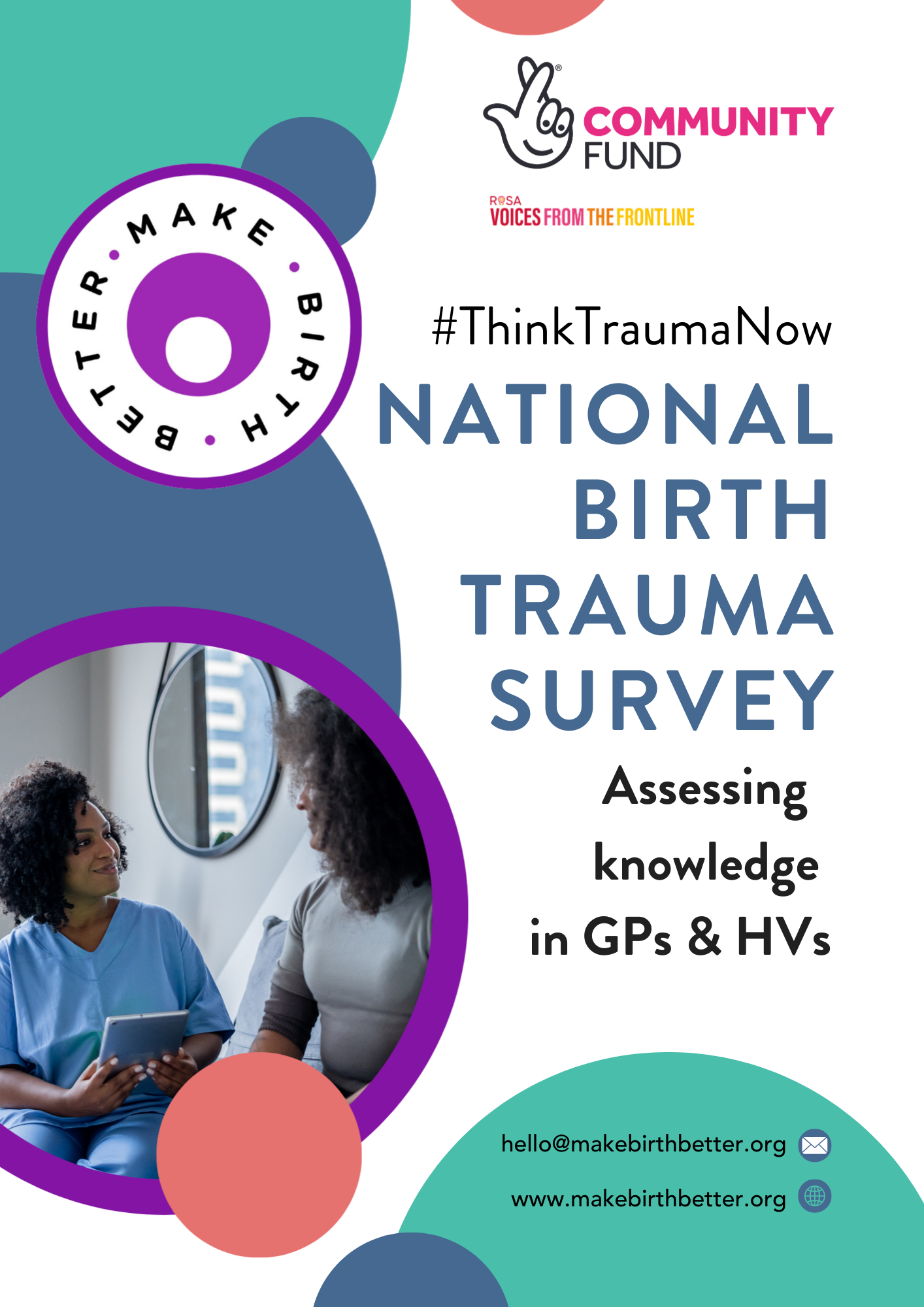
Our National Birth Trauma Survey for GPs and HVs looked into birth trauma awareness amongst GPs and HVs, their confidence in offering adequate support and the sufficiency of their training and professional knowledge.
The findings of these surveys have us worried, as they confirm the mismatch between parents and healthcare professionals, they highlight that birth trauma training is often not sufficient and they tell us support services are overstretched.
Calls to action
In our report, we’ve put together three calls to action we’re recommending to all GPs and HVs, including those who influence policy and practice, as well as Government leaders, NHS policy makers, the Royal College of GPs and the Institute of Health Visiting. “We’re looking at the feasibility and the barriers of these calls to action in some research we’re undertaking with the University of East Anglia, Birmingham University and City St George's”, explains Laura-Rose Thorogood (Make Birth Better CEO). Make Birth Better will use the findings of this research to promote these calls to action too.
Mandatory training on perinatal trauma for all GPs and HVs - ensuring they feel equipped on the basics of birth trauma and its symptoms, and they know where to signpost and send people for specialist referrals where required.
Training on the use of a quick screening tool (the City BiTS scale short form) - as part of mandatory training the use of this tool - developed by Professor Susan Ayres in collaboration with Make Birth Better and others - should be included.
Clear referral pathways on a local level, including clarity on capacity and insight in what support is available to prevent parents being sent around in circles unnecessarily long.
To read the full report, click here or click on the report image.
Join our mission
If you would like to know more about this topic, please check out our free training - Birth Trauma: Spotting the Signs here. If you’re a GP wanting to upskill around birth trauma and improve the support for your patients, please go to our free GP resources here.
If you're interested in supporting the campaign, we'd love to have you on board. Please sign up as a Make Birth Better Champion or contact us with any questions.
Next
Read about our Make Birth Better Campaign, our #everywordcounts campaign or return to campaign summary page.